Have you wondered about the new Alamance Parks logo? Why the fox, and what’s that in its mouth?
The new Alamance Parks logo was chosen to reflect unique elements of our parks system and community. We wanted to update the logo to a clean, modern design in line with current graphic trends to help make our park system more visible, but that also incorporated elements reflective of our community and area.
We chose the fox because it’s a unique animal that, while rarely seen, is still abundant in our area amongst our natural places. The leaf in its mouth belongs to the Tulip Poplar tree (Liriodendron tulipifera)– an interesting tree also very common in our area with highly recognizable and attractive leaves. In the badge version of the logo, the “NC” with the star was chosen to reflect the “NC” and star from the North Carolina State Flag. In the leaf icon version, the “AP” stands for Alamance Parks with the star element to reflect North Carolina. We selected these three different designs so that we would have logos that work for any purpose, be it a small square icon on a web tab, or a large badge on a festival sign.
You may also have noticed in the newsletter that there’s a unique logo for each branch of what we do. The Outdoors fox sports a backpack to reflect outdoor recreation activities available at our parks and hiking trails. The Community fox is shown with kits, to represent the families we serve through our Community Recreation Centers and Special Populations Programs. The Athletics fox sports a ball cap to represent our athletic offerings.
Fan of the new logo or just want to show support for your park system? We have bumper stickers and camo Tshirts featuring these designs. If you’re interested in purchasing one, please call (336) 229-2410 or email recinfo@alamance-nc.com. Bumper stickers are $1 and shirts are $15.
On August 27th from 10:00am to 4:00pm we will send off summer with our annual Preserving Our Heritage Festival. Join us at the Cedarock Historical Farm. Bring chairs or a blanket and enjoy live bluegrass music by Smokey Hollow; view demonstrations of old-time crafts and skills such as beekeeping and canning (vendors often have their crafts for sale as well); and peruse displays of antique tractors, cars, and farm equipment. The historic Garret Farm will be open with tours and living history demonstrations. We will have food available for purchase provided by Danny’s Cafe; Pelican’s Sno Balls will be on site; and this year we’ve also added face painting for extra family fun!
Volunteers needed! Please call (336) 229-2410 or email recinfo@alamance-nc.com if you’d like to help out.
It’s been an exciting year for the Haw River Trail in Saxapahaw. We’re excited to announce that we are working on a new park, the Saxapahaw Island Park, which will also be part of the Haw River Trail network. There are a lot of pieces that will fit together to make this park a reality:
In 2016, the HRT was awarded an $84,000 grant from the Recreational Trails Program to develop a loop trail and trailhead on the Island, as well as HRT trail extensions to the north and south of the Island. Thanks to acreage and an easement donated by Waste Industries and the Clore family, respectively, the Island will enjoy almost 2 miles of trail. This loop will connect to new planned Haw River Trail to the north of the Island, and to the existing and soon-to-be extended Trail section to the south across the river.
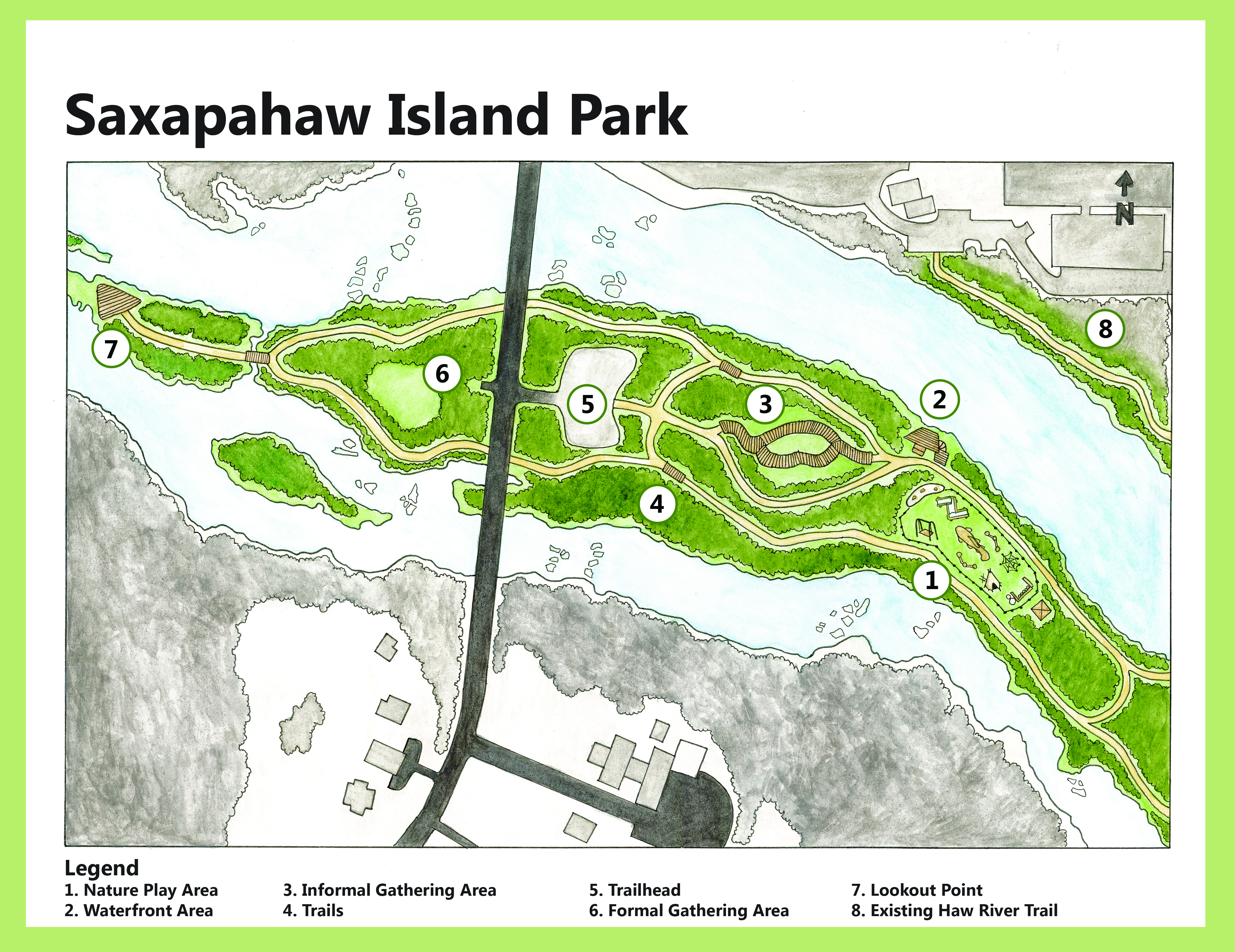
In addition to the hiking loop and trailhead, the new Saxapahaw Island Park will have an open formal gathering space that has been cleared by goat grazing; an informal gathering space that will contain a boardwalk and seating; a waterfront area with a deck overlooking the Haw River; and a nature play area. The gathering spaces and waterfront area are supported by community involvement and funds from Alamance Parks. The official site plan, hand drawn and painted by artist Dr. Elizabeth Bradshaw, shows our vision for the Island Park (click the map below for a close up look at the plan).
We are happy to announce we have also received a $100,000 grant from Impact Alamance to fund the nature play area. One of Impact Alamance’s primary objectives is to improve access to and quality of built play environments in our community. Currently, planned features include a central play structure shaped like a Bowfin fish that will offer multiple play elements; swings; a spider-web rope climber; outdoor musical play; a water sluice; a climbing wall; a fort building area; and balance beams connecting these play nodes. Each play feature will help children connect with and learn about natural elements of the Haw River ecosystem, with interpretive signage for each play node. If you are interested in learning more about the benefits of nature play, you can explore the Natural Learning Initiative’s website.
We also have exciting news for expansion of the trail south of the Island. The HRT recently received a generous donation from Buckner Companies in the form a beautiful new bridge that will allow extension of the trail past a previously unnavigable ravine, connecting existing trail to the new planned extension. Between the Island loop and the north/south extensions, the new trail developments will bring almost 4 miles of additional HRT to the Saxapahaw area. If you are interested in volunteering to help build trail, maintain trail, or work with the community group involved with the Island Park elements, please email info@thehaw.org.
As with the trails and trailhead, construction and installation for the play area will begin this winter. We tentatively look forward to a grand opening of the Saxapahaw Island Park in June 2017. A big thanks to the Recreational Trails Program, Impact Alamance, Alamance Parks, and Buckner Steel for their contributions to supporting the HRT in Saxapahaw, as well as to community members and local businesses whose support of HRT events has helped raise additional funds for this exciting new park.
If you’ve spent much time at Cedarock Park, you’ve probably noticed the abundance of Bluebirds and maybe the nest boxes scattered around the park. Over the next few newsletters we’re going to feature a plant or animal that you can see at our parks and share a little information about them- the beautiful bluebirds of Cedarock Park seemed an appropriate place to start! The nest boxes around the park are part of a dedicated bluebird breeding program which is monitored yearly to keep tabs on the population.
When you visit, the Bluebird you’re seeing is the Eastern Bluebird (Sialia sialis). There are also Western and Mountain Bluebirds, but they do not occur in North Carolina. The Eastern Bluebird, a member of the Thrush family (Turdidae), is easy to identify and is present year-round in our area. The males have bright blue backs and rosy/beige chests, while the females are duller in color. They have large eyes, plump bodies, and a short, straight beak. They sit alert on fence posts, power lines, and similar perches, from which they hunt their food- mostly bugs. In the fall and winter they will also eat berries. The Mountain Bluebird differs from its Eastern and Western counterparts in that it lacks the rosy chest and is instead shades of blue and gray all over.
Bluebirds like to live in habitats called “edges”- that is, open areas that also have a treeline. Suburban parks, golf courses, roadside fields, and similar places provide just the right place to live. They nest in provided boxes or in tree cavities, often in abandoned woodpecker holes. The bluebird song, which you can hear several samples of here, is low-pitched and made up of several notes. Next time you’re in the park, stop to listen and see if you can hear it! Another member of the thrush family that we have at our parks is the Wood Thrush, which you’ve likely heard if you’ve ever hiked the trails. They have a notably musical, flute-like song that is very distinctive and quite different than the bluebird’s more warbling, harsher notes.
Bluebirds photographed at the Cedarock Historical Farm.
Quick Facts
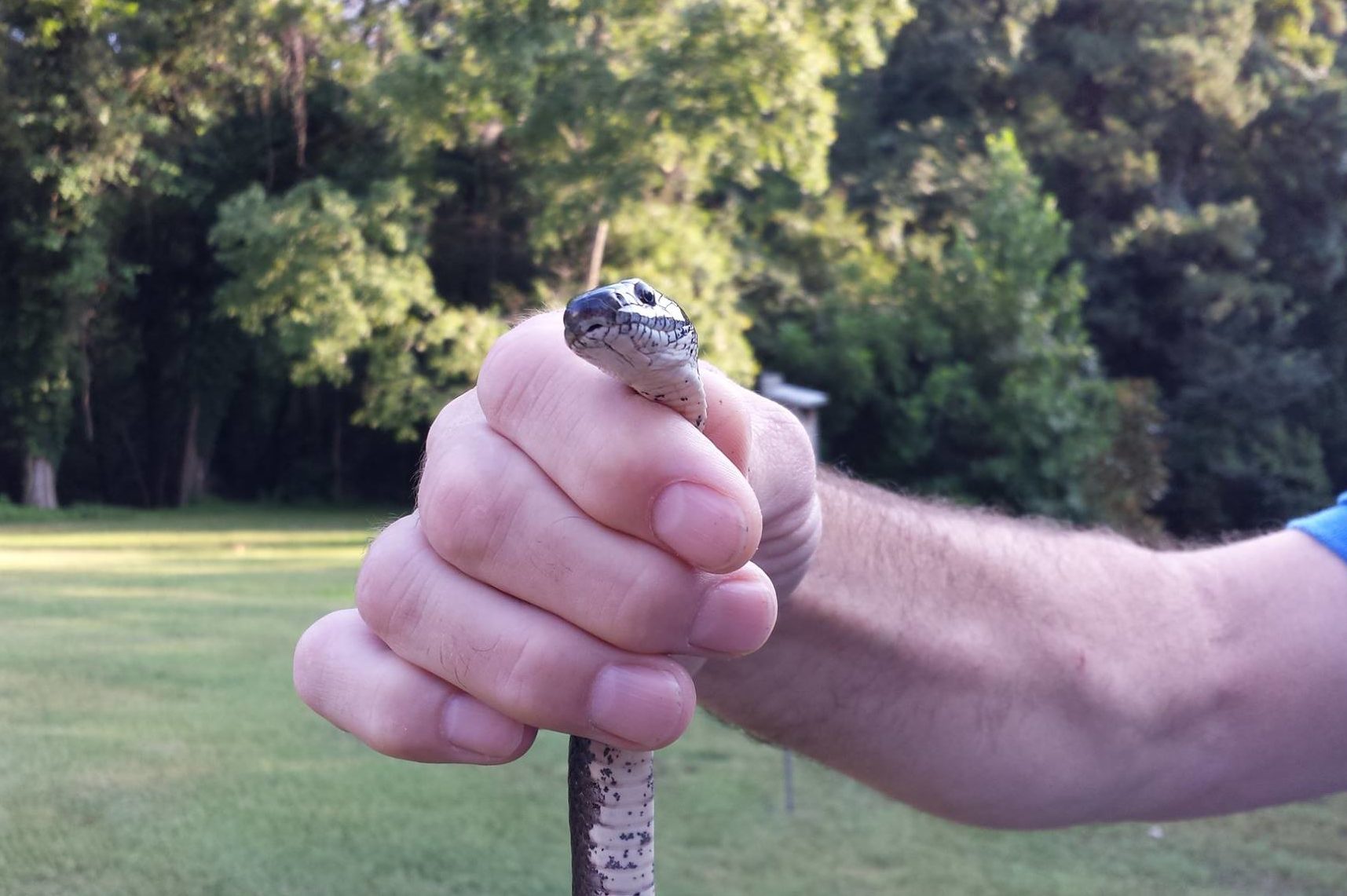
-You can attract bluebirds to your home and garden by building a bluebird nest box if you have open spaces with a treeline. Instructions for building your own nest box can be found here. Make sure to attach a guard to deter predators. You might have noticed the metal cylinders underneath the boxes in the park- these are predator guards that help keep out snakes and the like. This black rat snake, no doubt hoping for an egg breakfast, was pulled out of a cylinder by one of our staff members.
Black rat snake removed from the nest box guard under a bluebird box.
-To attract Bluebirds to your bird feeder, you will need to provide mealworms, as they are mostly insectivorous and won’t take seed. It can be difficult to attract them to feeders, so don’t despair if it doesn’t work well.
-Bluebird populations declined and were in danger in the early 1900s due to competition from invasive species and habitat loss. But, thanks to the dedicated efforts of bluebird trails and nest box campaigns that began in the 1960s, bluebird populations have recovered and they are no longer considered a species of concern.
-Bluebirds can spot the insects they eat from a height of 60+ feet! They favor caterpillars, spiders, crickets, and other bugs. They will suddenly drop from their perch to snatch their prey off the ground.
-A female Bluebird can lay 1-3 clutches of eggs per breeding season. Babies from the later clutches may stay with mom and dad throughout the winter. Bluebird eggs are light blue, just like a robin’s egg.
More Info
If you’d like to learn more about Bluebirds, or any other bird, the Cornell Lab of Ornithology website is a fantastic resource. There are also great smartphone apps for bird identification. For a review of the various apps available, check out this article from audobon.org. These are a great supplement or replacement for paper field guides and some apps even have song recognition features. There are also excellent field guides for identifying birds, including publications from National Geographic, the Audobon Society, and the Sibley Guide to Birds. You can find these guides, ranging from laminated pamphlets to full books, at bookstores, museums, online, or at your local library. If you’re really interested in learning more about birds, the only other bird watching tools you might want are a decent pair of binoculars and a journal to record your observations in.
Alamance Parks is hosting two American Hiking Society National Trails Day® events on Saturday, June 4, 2016. American Hiking Society’s National Trails Day® is a nationally recognized trail awareness program that occurs every year on the first Saturday of June and inspires the public to discover, learn about, and celebrate trails while participating in outdoor activities, clinics, and trail stewardship projects.
Want to celebrate with us? We’re holding Create a Natural Journal, a workshop at Shallow Ford Natural Area (SFNA) presented by Environmental Educator Kim Brown. Join us from 9:00-10:30am at the SFNA Observation Deck to learn about nature journals and enjoy exploring the Haw River Trail’s Shallow Ford Natural Area. Nature Journaling is a great way to record observations, perceptions and feelings about the natural world around you. Kim will share a brief overview of nature journals, then you will have a chance to use your creativity to make your own! No art experience necessary and all materials will be provided. Free and open to ages 16+. SFNA features 5 miles of passive use trails in and around the Haw River and a beautiful Wildflower Meadow surrounding the Observation Deck. If you would like to attend, please sign up on RecDesk at https://alamance.recdesk.com under “Programs.”
If you’re looking for something more active, we will also host a hike at Cedarock Park from 9:00am-10:30am, a guided hike on Cedarock Park’s Rock Creek Trail (the green trail). Join park technician TJ Mumford for this 2-mile hike, appropriate for all fitness levels. Rock Creek Trail winds through the woods, along Rock Creek, and past the mill dam waterfall. Free & open to the public. Meet at 9:00am at the middle park office (near the fishing pond). View a map of Cedarock Park and the Rock Creek Trail on our website (www.alamance-nc.com/recreation). No sign-up necessary for the hike.
Or, celebrate on your own! Alamance Parks’ trails and park facilities offer miles of trails and open spaces to explore and enjoy nature. Cedarock Park has 6 miles each of hiking and equestrian trails, Shallow Ford Natural Area offers over 5 miles of wooded trails, and the Haw River Trail access points offer both land and paddle opportunities to connect to the natural resources that surround us. For information on access points please visit www.thehaw.org or www.alamance-nc.com/recreation.
For more information about these events, email recinfo@alamance-nc.com or call (336) 229-2410. National Trails Day® is a registered trademark of American Hiking Society.
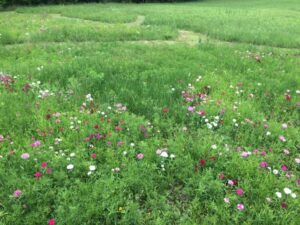
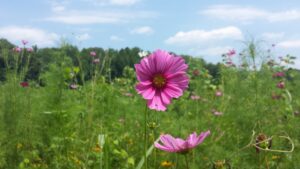
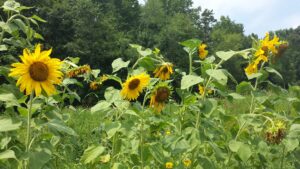
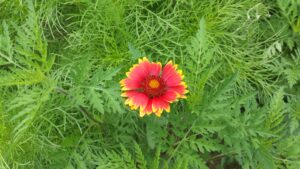
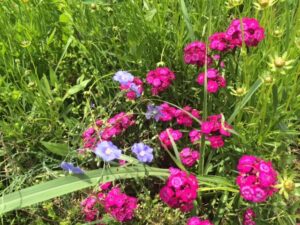
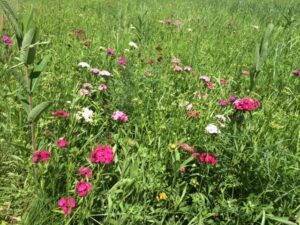
Did you know there’s a wildflower meadow at Shallow Ford Natural Area? With the arrival of spring and the warming weather, the flowers are starting to bloom and it’s a great time to visit. Early flowers are already showing their colors, including Sweet Williams (Dianthus barbatus), the Siberian Wallflower (Cheiranthus allionii), and a variety of daisies (Leucanthemum spp.). These are only the beginning, with many more to come as the season progresses, including Black-eyed Susan (Rudbeckia hirta), Blanket Flower (Gaillardia spp.), Queen Anne’s Lace a.k.a. Wild Carrot (Daucus carota subsp. carota), and more! As you can see in the photos, last year we enjoyed these flowers and many others, including some stunning giant sunflowers (Helianthus spp.) and widespread Cosmos (Cosmos spp.) in all shades of purple and pink. What’s special this year is that we will be seeing the first blooms from biennials planted last year and some of our perennials (read on to learn about the difference between annuals, biennials, and perennials).
The Observation Deck seen through a screen of tall Cosmos in summer 2015.
Establishing the Meadow
The Observation Deck located on the Basin Creek Trail (Orange Trail) was built last year to overlook the old field that has been converted into this home for wildflowers and wildlife. Last year, steps were taken to establish the wildflower meadow by seeding a portion of the area with a 60/40 perennial/annual mix. This year, a 70/30 perennial/annual mix was added to help finish establishing the field. Each year, a different annual mix will be added to the field for variety and experimentation, so you will always be able to enjoy something new! The meadow is set up so you can enjoy a panoramic view from the observation deck, or immerse yourself in the flowers by strolling mown paths between the different flower sections.
Flowers beginning to bloom amidst the paths in spring 2016.
The meadow creates an amazing ecosystem attracting all kinds of wildlife. In fact, this was one of the criteria in the original flower selection. Not only did we want flowers that show well and are hardy survivors, we also wanted to attract wildlife for observers to enjoy. The flower seed mixes were carefully selected to include plants both native to this area and from nearby regions. Some of the selected wildflowers are actually improved varieties of native wildflowers, meaning they’ve been bred from the original wild-type to have desirable qualities such as drought tolerance or nicer blooms.
The meadow attracts a variety of insects including butterflies, moths, different types of bees, and grasshoppers, as well as birds and other animals. Last year, we saw clearwing hummingbird moths (Hemaris spp.), which are a type of moth that looks and moves like a little hummingbird and is active during the day (you can learn more about these moths on the US Forest Service Website). The milkweed (Asclepias spp.) in certain areas of the field will remain uncut to encourage the Monarch Butterfly (Danaus plexippus) population. Monarch butterfly caterpillars only eat milkweed plants, making these plants essential to Monarch survival and great attractants for these beautiful butterflies. Milkweed plants form scaly green seed pods that dry up and release seeds attached to fluffy white filaments that cluster to form a coma, which helps the seeds wind-disperse. Milkweed is named for its latex-based milky sap.
Milkweed plant with seed pods forming.
The flowers will continue to bloom throughout the summer and the types of flowers in bloom at any given time may vary, so be sure to visit more than once!
Annuals, Biennials, and Perennials
Unless you’re already a plant enthusiast, by now you’re probably wondering what exactly perennial, biennial, and annual means…and why it matters for the wildflower meadow! These terms refer to a plant’s life cycle. An annual plant is one that completes its entire life cycle- from seed to vegetation to flowering then back to seed and death- in a single growing season (within one year, hence “annual”). The seeds may remain and grow into new plants the following year if conditions are right, but the parent plant dies after seed. Many Cosmos are annuals, and others include Cornflowers (Centaurea), Coreopsis, and Red Poppy (Papaver rhoeas).
A Cosmos in bloom.
A biennial plant takes two years to complete its life cycle- the first year is devoted to vegetative growth, meaning roots and foliage but not flowers or seed. It’s in the second year that you get flowers and seed, then the parent plant dies. So, for an example in the wildflower meadow, the Sweet Williams and Siberian Wallflowers that were seeded last year are blooming for the very first time this year! Some other common biennials include Foxgloves (Digitalis spp.), Brussels sprouts (Brassica oleracea), Celery (Apium graveolens), and some Blanket Flowers.
A perennial plant’s life cycle can take two or more years to complete from seed to seed. Generally, you will get flowers by the second year, but not always. The difference between perennials and annuals or biennials is that the parent plant of a perennial does not die after producing seeds. Parts of the plant may die back to the ground over winter but will sprout again come spring. Some varieties of Black Eyed Susan, Sunflowers, and Blanket Flowers are perennials. Other common perennials include Purple Coneflower (Echinacea spp.), Ox-Eye Daisy (Leucanthemum vulgare), and other species of Daisies.
Sunflowers
The terms can get a little confusing because some plants behave differently depending on the geographic region they are growing in and its climate. Also, for many plants, hybrids and different varieties have been produced that may demonstrate different life cycles than the original plant. For example, there are both annual and perennial varieties of Sunflowers and Black Eyed Susan.
Blanket Flower
The fun result of these different life cycles is that this variety allows the meadow to have both more constantly-established flowers (perennials) and then a mix of flowers that will come and go depending on what is seeded in a given year (this would depend on the annuals, biennials, and types of perennials planted each year). So the biennial Sweet Williams you see this year will not be there next year- unless we planted new Sweet William seeds this year! You’ll just have to come back and see…
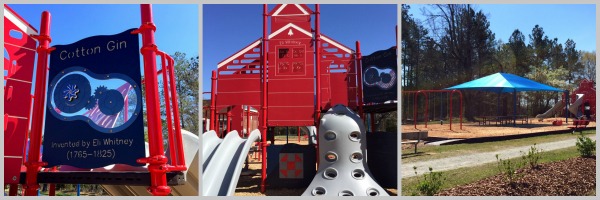
Alamance Parks is pleased to announce the completion of a new playground at Eli Whitney Recreation Center located at 4110 E. Greensboro-Chapel Hill Rd., Graham, NC 27253. The new playground was funded by a grant from Impact Alamance as part of their focus on building healthy environments to increase access to physical activity for children and families. The playground was installed last month and includes a sunshade with picnic tables, perimeter benches, spring riders, a main play area platform, multiple slides, two climbing features attached to the platform, pod climbers, monkey bars, and more. Eli Whitney also has new landscaping completed in conjunction with the playground. The walking track still circles the playground.
The playground was designed to reflect the culture and history of Eli Whitney, with a focus on the Center’s original use to house cotton gins, its later life as a school, the Uncle Eli’s Quilting Party which just held its 85th annual event, and the textile history associated with Alamance County. The main play area platform is shaped like an old-time schoolhouse. It features panels with quick facts about the history of the original school and of textiles in Alamance County, a panel showcasing the Uncle Eli’s Quilting Party, and a panel about cotton gins with an interactive gear and crank mechanism that kids can play with. The spring riders are shaped like Boll Weevils, part of the cotton and textile theme.
Come out to see the new playground, enjoy a family picnic, or walk the track while your kids play! The Recreation Center also features open gym hours, fitness center hours, and more to come.
Join us May 21st from 1pm-4pm at the Cedarock Park Historical Farm for a presentation by NC-certified beekeepers Ira Poston of Blueberry Hill Apiaries and Paul Jollay of the Glencoe Honey Company. Ira and Paul join us again this year to present a workshop on beekeeping practices, past and present. They will have honey to sample, honey for sale, a demonstration hive, take-home seeds to grow your own bee-friendly flowers, and copies of their favorite reference materials for participants to look through. Ira & Paul’s presentation was a favorite last year- don’t miss it!
Ira and Paul are members of the Alamance County Beekeepers, a chapter of the North Carolina State Beekeepers Association. Beekeeping will kick off the second year of the Foxfire in Cedarock Park program, a series of workshops celebrating Appalachian culture and tradition. Other programs to look forward to this year include canning in June, wood turning in July, the Preserving Our Heritage Festival in August, soapmaking in September, and the Fall Festival in October which features old-time farm games followed by Ghosts in the Park storytelling in the evening. Last year we celebrated mountain music, beekeeping, canning, the Heritage Festival, pottery, and the Fall Festival/Ghosts in the Park.
All programs are free and open to the public. Workshop leaders will share information about their trade, both how it was done in the past and modern practices. All programs include live demonstrations and/or hands-on activities, with information for participants to take home to learn more about the craft or trade. The Foxfire in Cedarock Park series is co-sponsored by Alamance Parks and Alamance County Public Libraries.
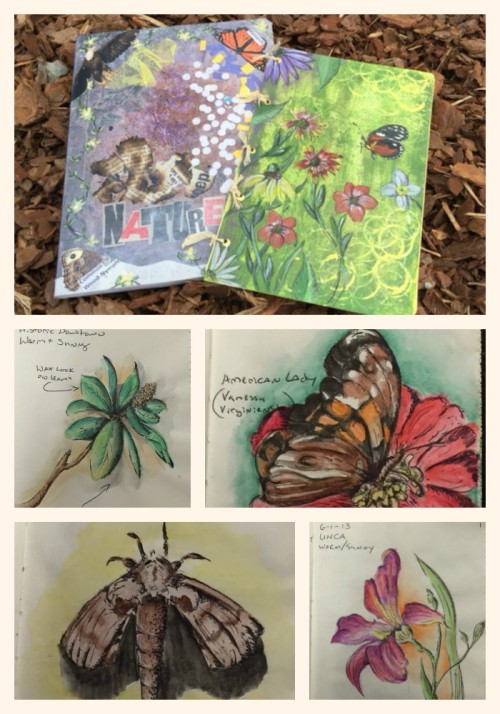
We’re offering an introductory Nature Journal workshop at Shallow Ford Natural Area (SFNA) on June 4th, 2016, from 9:00am-10:30am. Join Environmental Educator Kim Brown at the Observation Deck to learn about nature journals and enjoy exploring SFNA. Kim will share a brief overview of natural journals and then you will have the chance to use your creativity to make your own journal. You will have time to complete your first journal entries at SFNA. No art experience necessary and all materials will be provided. Free and open to ages 16+. Limited space so sign up now on RecDesk!
Nature Journaling is a great way to record observations, perceptions and feelings about the natural world around you. Nature journals have a long history, and were kept by famous naturalists such as John Muir (founder of the Sierra Club), John James Audobon (renowned for his ornithological art), and Charles Darwin (iconic naturalist). They’ve served many purposes, including scientific observation, artistic expression, inspiration and source material for books, and more. Most importantly, they’re a great way to connect with nature and express your creativity.
There are many kinds of nature journals- there is no right or wrong way to make them and the possibilities for creativity are endless. They can include pressed flowers and leaves, sketches, written observations, logs of the seasons, and more. You can find numerous nature journal resources online, such as the introductory information page provided by the Sierra Club. Try searching for Nature Journals on Pinterest to find ideas and inspiration for what to include in yours and admire some impressive examples!
Photo Credit: The Nature Journals and journal pages featured in the photographs on this page are the work of Kim Brown, who will be leading the workshop.
References: Reference information about Nature Journals found on the Sierra Club website (see link above) and Wikipedia.
Join us in Saxapahaw for the 9th Annual YeeHaw! River Paddle on Saturday, May 14, 2016, from 9:00am-finish. The Yee-Haw! River Paddle brings together paddlers of all skill levels to share the Haw River as a community. The YeeHaw! River Paddle is held each year on a different section of the Haw River Paddle Trail to help the community connect to the river and enjoy the opportunity to paddle. The recent construction of Union Bridge Paddle Access in March completes the Paddle Trail through Alamance County. The 2016 YeeHaw! Paddle will end at Union Bridge Paddle Access to celebrate access to this final stretch of river through the county.
This year’s event features two paddles, a Family & Beginners’ Paddle in the morning and the Yee-Haw! River Paddle in the afternoon. The cost for each event is $20/adult and $10/child (12 & under). All proceeds benefit the Haw River Trail. The Family & Beginners’ Paddle will be held on Saxapahaw Lake, featuring calm flat water ideal for families and new paddlers. The more challenging YeeHaw! River Paddle in the afternoon will put in at Saxapahaw Mill Race Paddle Access and take out at the newly completed Union Bridge Paddle Access. This 5-mile stretch is suitable for intermediate paddlers, featuring moving water and intermittent rapids with beautiful views of the river and its wildlife.